
Semiconductor Quartz vs. SiC Tubes and Boats: A Diffusion/Oxidation Comparison Guide
Short answer: specify quartz when the recipe stays inside the quartz thermal envelope — 1150 °C continuous and 1300 °C short-term for the wafer boat, with furnace tube hydroxyl content controlled below 20 ppm, or below 5 ppm in the low-hydroxyl grade — and specify CVD SiC-coated SiSiC hardware when the furnace must run above that window, hold dimensional stability across repeated thermal cycles, or survive LPCVD chemistry. The SiC wafer boat is rated to 1600 °C with zero structural deformation, the SiC furnace tube is built for LPCVD and high-temperature oxidation with ±0.2 mm wall thickness uniformity and vacuum-tight gas impermeability, and the quartz boat holds SiO2 purity at 99.99% or higher with slot pitch tolerance of ±0.05 mm or tighter.
This guide compares the two material families on the four specifications that actually settle a purchase: purity and hydroxyl control, thermal process compatibility, dimensional stability, and dimensional envelope. It is written for process engineers, fab procurement teams and OEM buyers who already know the furnace and now have to defend a material choice in a qualification review.

The Problem: One Furnace, Two Material Envelopes
A diffusion or oxidation stack is not a single-material system. A typical horizontal or vertical furnace pairs a process tube, a wafer boat, a paddle or cantilever beam, and gas injectors — and each of those parts can be specified in a different material. The purchasing question is therefore not “quartz or SiC” in the abstract. It is four constraints that have to hold at the same time:
- Purity and hydroxyl control. For quartz tubes this is the hydroxyl (OH) content: below 20 ppm standard, below 5 ppm for the low-hydroxyl grade. For quartz boats it is SiO2 content at 99.99% or higher in GE214 or equivalent ultra-high purity fused quartz.
- Thermal process compatibility. The quartz wafer boat is rated 1150 °C continuous and 1300 °C short-term. The SiC wafer boat is rated up to 1600 °C with zero structural deformation. Recipes outside the lower window remove quartz from the option set entirely.
- Dimensional stability. Slot pitch tolerance of ±0.05 mm or tighter on the quartz boat; wall thickness uniformity of ±0.2 mm and outer diameter tolerance of ±1.0% or better on the tube. These are the numbers that decide whether a part seats correctly in existing hardware.
- Dimensional envelope. The SiC furnace tube is available up to 3000 mm in length. When the furnace is long, envelope availability can decide the material before any performance argument begins.
The failure modes are asymmetric, which is why buyers keep revisiting the decision. A quartz part that drifts dimensionally shows up as fit problems and batch-to-batch variation; a tube that is not gas-tight under vacuum shows up as contamination and particle excursions. Neither failure is visible on a datasheet, and both are expensive to diagnose after the fact. That is the reason the specification work belongs in procurement, not in the post-mortem.
Industry Background: Why the Default Is No Longer Automatic
SEMI reported the global semiconductor materials market at USD 85.80 billion in 2025, covering wafer fabrication and packaging materials (SEMI, 2025). Growth of that base is driven by demand for advanced chip fabrication, and industry analysis links that demand to tighter process windows across the fab (Stanford Emerging Technology Review, 2025). The practical consequence for furnace hardware is straightforward: when process windows tighten, the tolerance stack in the tube and the boat becomes a process variable rather than a mechanical detail.
Quartz remains the reference material for oxidation and diffusion because it is well understood, widely qualified and available in the purities the process needs. What has changed is the number of recipes that no longer fit inside the quartz window. High-temperature oxidation, LPCVD with corrosive gas-phase chemistry, and long campaigns that accumulate thermal cycles all push buyers toward silicon carbide hardware that carries a higher working temperature and a documented service life advantage — the SiC wafer boat is specified at more than 5× the service lifespan of traditional quartz boats.
The result is a mixed installed base. Many fabs run quartz tubes with quartz boats on standard oxidation, SiC tubes and SiC boats on the hotter or more aggressive steps, and a mixture of the two on furnaces that were qualified years apart. That mixture is exactly where specification errors happen, because the two families do not share tolerances, temperature ratings or atmosphere limits.
Detailed Solution: What Each Option Actually Specifies
Quartz furnace tube: hydroxyl content is the controlling number
The quartz furnace tube is a high-purity fused quartz process tube and reaction chamber. Its documented parameters are hydroxyl content below 20 ppm, or below 5 ppm for the low-hydroxyl type; outer diameter tolerance of ±1.0% or better; sagging resistance optimised for vertical and horizontal orientations; and a bubble- and inclusion-free surface. It is applied in annealing and diffusion processes.
Hydroxyl content is the first number to negotiate, because it is the parameter that expresses how the tube behaves under sustained thermal load. Higher hydroxyl content is generally associated with greater sag risk at temperature, so the choice between the sub-20 ppm grade and the sub-5 ppm grade is effectively a decision about how much dimensional drift the recipe can absorb over a tube campaign. The ±1.0% outer diameter tolerance works the same way: tube-to-flange and tube-to-baffle clearances are fixed by the furnace, and a tube at the edge of tolerance consumes fit allowance that the boat and paddle also need.
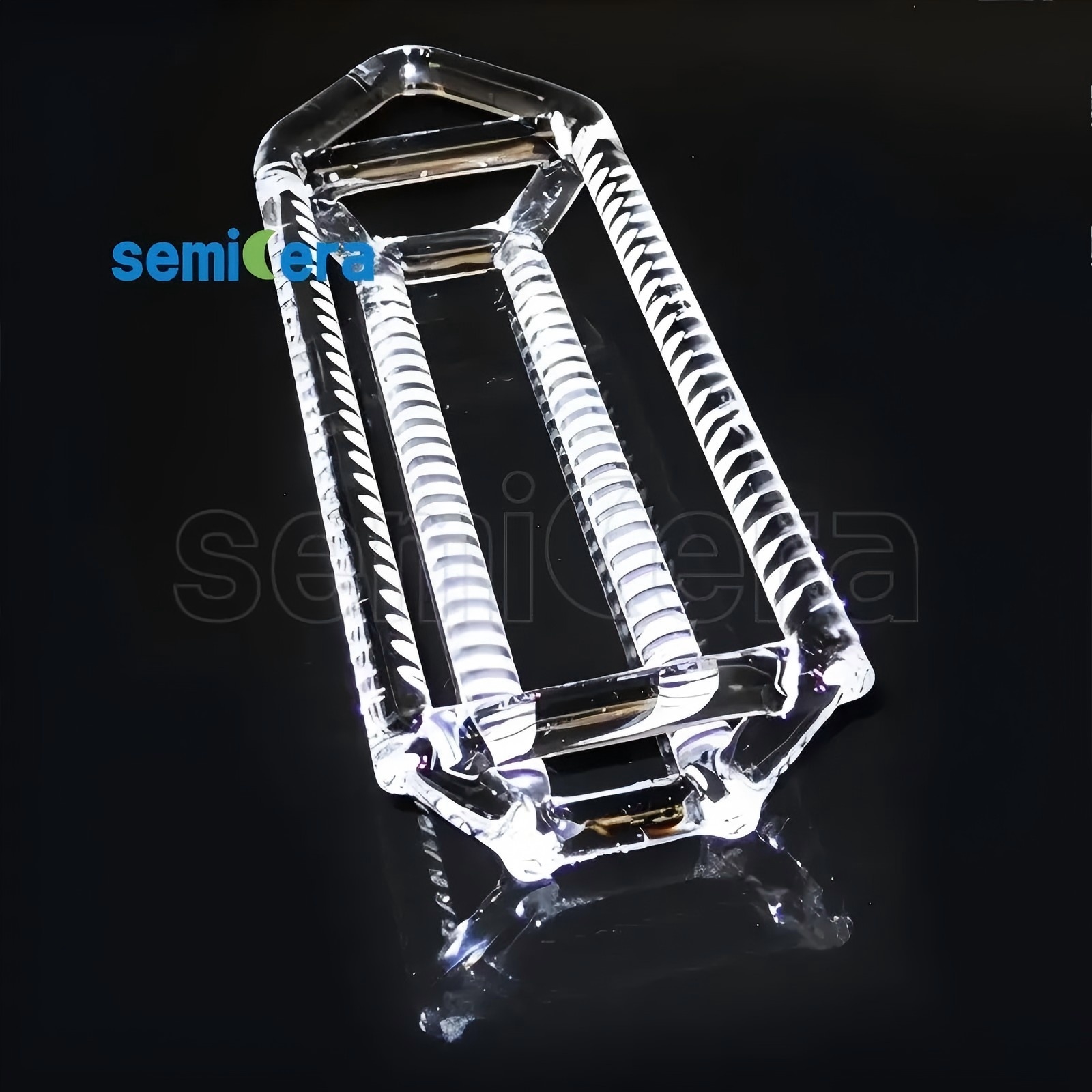
Quartz wafer boat: slot pitch and SiO2 purity
The quartz wafer boat is a diffusion and oxidation batch carrier for horizontal or vertical use. It is made from GE214 or equivalent ultra-high purity fused quartz with SiO2 content of 99.99% or higher, rated for continuous operation at 1150 °C and short-term operation up to 1300 °C, with slot pitch tolerance of ±0.05 mm or tighter.
Slot pitch is the tolerance most often quoted when a fab compares quartz boats from different suppliers, because slot geometry is what locates every wafer in the batch. A boat that meets the pitch tolerance on drawing but drifts after thermal cycling is a boat that will be re-measured at incoming inspection. Ask for the pitch tolerance and the measurement method together.
SiC furnace tube: CVD SiC coating on SiSiC
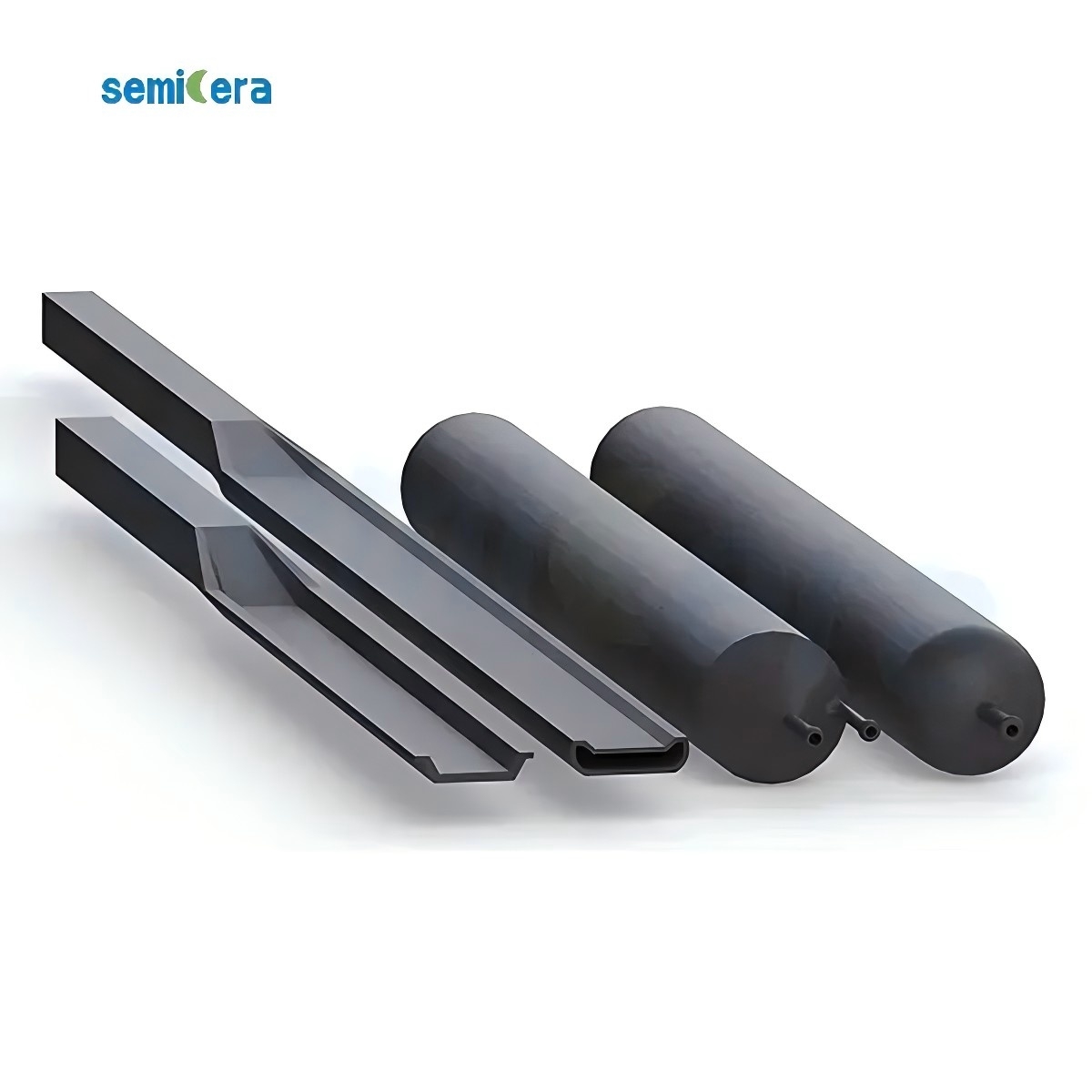
The SiC furnace tube (model SiC-02) is a CVD SiC coating on a SiSiC substrate, specified for LPCVD and high-temperature oxidation. Documented properties are: maximum length up to 3000 mm, wall thickness uniformity of ±0.2 mm, impermeability to gases under vacuum, and thermal conductivity of 20–30 W/m·K at 1200 °C. It is intended for corrosive gas-phase deposition environments such as DCS and TCS chemistries, where the application requirement is thermal stability, corrosion resistance and reduced particle generation.
The gas-tightness statement changes the purchasing logic more than any other line on the sheet. A tube that is impermeable to gases under vacuum closes a path that would otherwise let process gas and reaction by-products interact with the substrate and with the furnace environment. The thermal conductivity figure of 20–30 W/m·K at 1200 °C is the number to feed into the furnace thermal model when a SiC tube replaces quartz, because the axial thermal profile will not be identical.
SiC wafer boat: SiSiC or RSiC substrate with CVD SiC coating
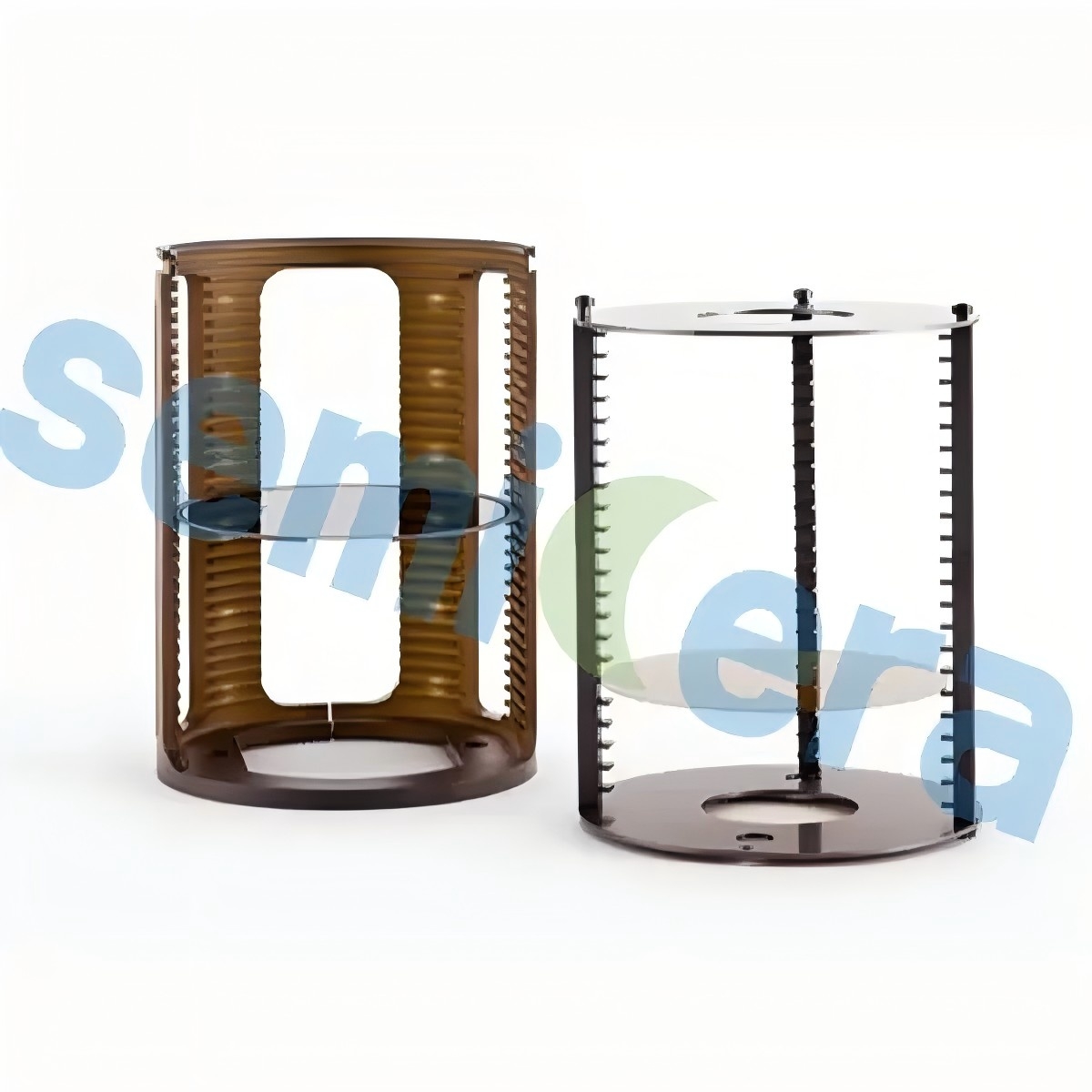
The SiC wafer boat (model SiC-01) is a recrystallised or sintered silicon carbide diffusion boat available on a SiSiC (sintered SiC) or RSiC (recrystallised SiC) substrate with CVD SiC coating. Maximum working temperature is up to 1600 °C with zero structural deformation, documented service lifespan is more than 5× that of traditional quartz boats, and thermal shock resistance is rated for 1000 °C to room-temperature cycles.
Two of those three numbers are procurement numbers rather than engineering numbers. The 1600 °C rating is what removes quartz from the option set for hot recipes. The 5× lifespan statement is what reframes the purchase as a replacement-frequency decision instead of a unit-price decision. The thermal shock rating is what makes the 5× claim usable in a furnace that cycles rather than runs continuously.
The loading side: SiC paddle
Tube and boat decisions usually fail at the loading interface. The SiC paddle (model SiC-03) is a cantilever loader beam on a sintered RSiC core matrix with a ground, particle-free surface, rated for deflection of 2.0 mm or less at maximum reach beyond 2000 mm, and a load capacity of up to 15 kg at temperatures above 1100 °C, with customisable lengths in the 1500–3500 mm range. If the boat plus wafer load sits outside the paddle's deflection budget at temperature, the boat specification is moot.
Step-by-Step: Specifying a Tube-and-Boat Set
- Fix the thermal budget first. Establish peak temperature and dwell. If the peak stays at or below 1150 °C continuous, or 1300 °C short-term, the quartz wafer boat is inside its rating. If the peak exceeds that, the boat decision is made before any price discussion.
- Define the atmosphere and chemistry. Inert and oxidising ambients are the quartz baseline. Corrosive gas-phase deposition pushes toward a CVD SiC-coated SiSiC tube for impermeability to gases under vacuum and documented corrosion resistance.
- Lock the dimensional envelope. Specify tube length up to 3000 mm, wall thickness uniformity ±0.2 mm, outer diameter tolerance ±1.0% or better, and boat slot pitch tolerance ≤ ±0.05 mm. Put the measurement method on the purchase order, not just the value.
- Set the purity and hydroxyl limits. Tube hydroxyl below 20 ppm, or below 5 ppm where the process is most sensitive; boat SiO2 at 99.99% or higher in GE214 or equivalent fused quartz. Do not accept a certificate that states a grade without the measurement basis.
- Check the mechanical duty. Confirm boat load, paddle deflection limit of 2.0 mm or less at maximum reach, and the thermal cycling profile the boat will see, including the 1000 °C to room-temperature cycle rating on the SiC boat.
- Close out qualification and supply. Verify item-level certification, 100% test on supplied parts, MOQ of 1 unit for validation, and a 30–50 day lead time against the installation window.
Use Cases: Four Configurations and Why They Work
1. Standard oxidation inside the quartz window — all-quartz set
A furnace running oxidation or anneal at or below 1150 °C continuous is fully served by a quartz tube and a quartz boat. The tube supplies hydroxyl control below 20 ppm and a sag-resistant geometry; the boat supplies 99.99% SiO2 and ±0.05 mm slot pitch. Nothing in this configuration requires silicon carbide, and adding it raises cost without changing the process capability.
2. High-temperature oxidation or anneal above the quartz short-term limit
Once the recipe exceeds 1300 °C short-term, the quartz boat is outside its rating and the SiC boat at up to 1600 °C with zero structural deformation becomes the only documented option. Pair it with a SiC tube so the tube and boat share a thermal expansion environment at temperature. This is the configuration where the 5× service lifespan matters most, because the parts are running close to the top of the range.
3. LPCVD with corrosive gas-phase chemistry
DCS and TCS chemistries are the reason the SiC furnace tube exists as a separate specification rather than a variant of quartz. The impermeability to gases under vacuum and the corrosion resistance requirement are the selection criteria; particle generation is the measured outcome. The same furnace usually takes a SiC boat, because the tube upgrade is pointless if the carrier is dimensionally drifting at temperature.
4. Mixed set where thermal budget and budget diverge
Some fabs run an SiC tube for chemistry and a quartz boat because the recipe is thermally inside the quartz window and the boat is the lower-commitment part. This configuration works, but only if the boat rating is checked against the actual peak rather than the set-point. A quartz boat at 1150 °C continuous in a furnace that overshoots to 1300 °C short-term on ramp is a boat living at its limit every cycle.
Comparison Table
Table 1 compares only the specifications documented for these four part families. Where a parameter is not stated in the source specification, the cell says so rather than carrying an assumed value.
| Parameter | Quartz furnace tube | Quartz wafer boat | SiC furnace tube (CVD SiC on SiSiC) | SiC wafer boat (SiSiC / RSiC) |
|---|---|---|---|---|
| Construction | High-purity fused quartz reaction chamber | GE214 or equivalent ultra-high purity fused quartz | CVD SiC coating on SiSiC substrate | SiSiC or RSiC substrate with CVD SiC coating |
| Purity / hydroxyl | OH below 20 ppm; low-hydroxyl type below 5 ppm | SiO2 99.99% or higher | Not stated on the tube sheet; coating-level specifications are quoted separately | Not stated on the boat sheet; coating-level specifications are quoted separately |
| Maximum working temperature | Not stated; hydroxyl content and sagging resistance are the controlling parameters | 1150 °C continuous, 1300 °C short-term | Not stated; rated for LPCVD and high-temperature oxidation, thermal conductivity 20–30 W/m·K at 1200 °C | Up to 1600 °C with zero structural deformation |
| Dimensional control | Outer diameter tolerance ±1.0% or better; bubble- and inclusion-free surface | Slot pitch tolerance ±0.05 mm or tighter | Wall thickness uniformity ±0.2 mm; maximum length 3000 mm | Slot geometry defined per drawing; substrate grade SiSiC or RSiC selectable |
| Atmosphere / chemistry | Annealing and diffusion service | Diffusion and oxidation service | Impermeable to gases under vacuum; corrosive gas-phase deposition such as DCS/TCS | High-temperature diffusion service, including corrosive gas environments |
| Thermal shock / mechanical | Sagging resistance optimised for vertical and horizontal orientation | Not stated beyond temperature ratings | Not stated beyond thermal conductivity data | Rated for 1000 °C to room-temperature cycles |
| Documented service life | Not stated | Baseline reference for boat life | Not stated | More than 5× traditional quartz boats |
| Best process fit | Oxidation, annealing, diffusion within quartz ratings | Batch oxidation and diffusion within 1150 °C continuous | LPCVD and high-temperature oxidation with corrosive chemistry | High-temperature diffusion, long campaigns, high thermal cycling |
How to read this table: the two quartz columns and the two SiC columns are not interchangeable within their own family. A quartz tube rating and a quartz boat rating are separate specifications, and a SiC tube rating and a SiC boat rating are separate as well. Qualification documents frequently quote the family and not the part, which is where mismatches enter the file.
FAQ
Which certifications should I verify before approving a quartz or SiC furnace set?
Ask for item-level certificate coverage, not a company logo. The documented certificates are ISO 9001, ISO 14001 and ISO 45001, issued by ISO, valid for the global market, with an issue date of 2025-12-01 and an expiry date of 2026-12-01. Documented item coverage is: ISO 9001 covering the CVD TaC coating graphite carrier (CVD-02, ID 4920), the SiC wafer boat (SiC-01, ID 4926), the SiC furnace tube (SiC-02, ID 4927) and semiconductor graphite (ID 4932); ISO 14001 covering the SiC wafer boat (ID 4926) and semiconductor graphite (ID 4932); ISO 45001 covering the CVD SiC coating graphite carrier (CVD-01, ID 4919), the SiC wafer boat (ID 4926), the SiC furnace tube (ID 4927) and semiconductor graphite (ID 4932). Certificate scope is item-specific, so confirm the coverage for quartz tubes, quartz boats and other components directly with the supplier before you write the certificate number into a qualification file.
Can a quartz boat and a SiC boat be used in the same diffusion furnace?
They can be used on the same furnace platform, but they are not interchangeable at the recipe level. The quartz wafer boat is rated 1150 °C continuous and 1300 °C short-term; the SiC wafer boat is rated up to 1600 °C with zero structural deformation, so the SiC envelope covers every quartz recipe but not the reverse. Below 1300 °C short-term the decision turns on other variables: slot pitch tolerance of ±0.05 mm or tighter on the quartz boat, a SiC service lifespan documented at more than 5× quartz boats, and the 1000 °C to room-temperature cycle rating. Check the loading side as well — the SiC paddle is rated for 2.0 mm or less deflection at maximum reach beyond 2000 mm and up to 15 kg above 1100 °C, and the boat plus load has to sit inside that budget.
What drives the cost of a quartz versus SiC tube-and-boat set?
Unit prices are quotation-specific and are not published in this guide; the structural cost drivers are documented and can be compared directly. The SiC wafer boat carries a service lifespan stated at more than 5× traditional quartz boats and is rated for 1000 °C to room-temperature cycles, so the comparison is replacement frequency and campaign interruption rather than purchase price alone. The quartz wafer boat is rated 1150 °C continuous and 1300 °C short-term, which caps the recipes where it can be used at all. On the tube side, the SiC furnace tube carries a 3000 mm maximum length and ±0.2 mm wall thickness uniformity, so dimensional non-recurrence — re-machining, re-qualification, fit corrections — often dominates the total. Quote against the actual drawing, not a catalogue size.
Can I validate a single tube or boat before committing to volume?
Yes. The stated capability terms are MOQ of 1 unit, 100% test on supplied parts, OEM production mode with voltage and logo customisation, and remote after-sales support, with export markets covering the EU, USA and Asia. A single-unit order is the practical way to confirm slot pitch, wall uniformity, surface condition and fit against the furnace before a volume release. Send the drawing to sales05@semi-cera.com to request a sample and a quotation built on that drawing.
What lead time and capacity should I plan for?
The stated lead time is 30–50 days with monthly capacity of 10,000+ units and 100% test, which means drawings should be released roughly 6–8 weeks ahead of the installation window for a furnace rebuild or a multi-tube campaign. For a first order that includes sample validation, plan the sample review as a separate gate before the volume release so that dimensional approval is not compressed into the production lead time.
Conclusion: A Decision Rule You Can Apply in Ten Minutes
Start with the peak temperature. If the recipe stays at or below 1150 °C continuous and 1300 °C short-term, the quartz wafer boat is inside its rating and the quartz furnace tube with hydroxyl below 20 ppm — or below 5 ppm where the process is most sensitive — is the compatible partner. Verify SiO2 at 99.99% or higher and slot pitch at ±0.05 mm or tighter, and the dimensional basis is closed.
If the recipe goes above that window, or the chemistry is LPCVD with corrosive gas, the decision moves to silicon carbide. Specify the SiC wafer boat at up to 1600 °C on a SiSiC or RSiC substrate with CVD SiC coating, and pair it with a CVD SiC-coated SiSiC tube so the tube shares the thermal environment and provides gas impermeability under vacuum with ±0.2 mm wall uniformity and lengths to 3000 mm.
Whatever the outcome, the specification that protects the purchase is item-level: per-part temperature rating, per-part tolerance with its measurement method, and per-part certificate coverage. Families are not specifications.
Next step: validate against your drawing
Semicera (Ningbo Miami Advanced Material Technology Co. LTD) manufactures CVD SiC coatings, TaC and PyC coatings, silicon carbide ceramics, semiconductor graphite, quartz components and carbon fibre composite parts for semiconductor hot-zone applications, with ISO 9001, ISO 14001 and ISO 45001 certification documented for the covered product families.
Send the furnace drawing and the recipe window to sales05@semi-cera.com for a sample and a quotation, or download the product catalogue: Semicera Catalogue 2025. Product portfolio and technical data: www.semi-cera.com.
Tel / WhatsApp: +86 15957878134 · Address: Ningbo, China
Have Questions or Need More Details?
Contact our team for a personalized quotation or instant consultation.
Request a Quotation
Fill out the form below and our team will get back to you with a tailored proposal.
WhatsApp Direct Chat
Prefer to chat in real-time? Message us on WhatsApp for instant assistance & quick answers.
- Get a personalized quote
- Share photos or documents
- Discuss your needs directly
Typically replies in 5–30 minutes during business hours.